The true mark of great art is whether it stirs some shit up inside you. Not just kicks up a little dust — I mean really lets loose. Tornadoes. Avalanches. Hurricanes of feeling you didn’t know were sitting there waiting.
Great art is the key that unblocks a jumble of inchoate emotions inside you. A sledgehammer to the dam holding back everything you haven’t been able to articulate about what it feels like to be alive. It’s also a mirror — one that shows you the things you’re actively trying not to see. And in showing you, it helps you make sense of them.
This was the first thought I had after I finished watching Train Dreams.
This isn’t a movie review. The last thing this world needs is another pretentious, douchey movie reviewer. That said, my first instinct after watching the movie was to quickly write a post that, in hindsight, would have sounded exactly like one — I was reaching for words like beautiful, poignant, evocative, devastating, touching, heart-warming. All the clichéd words you’d associate with a movie of this emotional intensity.
What I actually want to do is write about how the movie made me feel. The images it put in my head. The thoughts and emotions it unlocked. That feels like a more honest description of the film than another douchey review.
Train Dreams is based on a Pulitzer Prize–nominated novella of the same name by Denis Johnson. The movie revolves around the life of Robert Grainier, who’s orphaned at a very young age and finds himself on a train with a note pinned to his chest that reads “Fry, Idaho.” Nobody ever told him how he lost his parents. He doesn’t even know his year of birth for certain. Then somehow he gets adopted by a family in Bonners Ferry, Idaho.
Robert Grainier drifts through his childhood and youth without any direction or purpose. He drops out of school and doesn’t really get interested in anything. His early years are pretty much a blur.
In 1917, he joins a railroad crew despite having no experience with that kind of work. This was the era when railroads were snaking their way through the pristine, untouched wilderness of the Pacific Northwest, stitching the whole country together and opening it up to the great engines of progress. The cost was scars across that wilderness — vast, ancient forests cleared to make way for the tracks.
Joel Edgerton plays Robert Grainier, and the leading lady is Felicity Jones as Gladys. Both are absolutely brilliant. Joel Edgerton in particular is remarkable — if he had won an Oscar for this performance, it would have been well deserved.
Even though the movie is set in the early 1900s, it has clear echoes in the present.
After Grainier joins the railroad crew, he immediately regrets it. One of his first experiences on the job is horrendous: a group of white railroad workers grab a Chinese laborer working alongside them and throw him off a bridge. The incident haunts Grainier for the rest of his life.
In fact, Grainier gets a glimpse of just how capable of violence and brutality humans are even earlier in life. As a child, he watches more than a hundred Chinese families being deported from his town. “Grainier was baffled by the casualness of the violence,” as the narrator puts it.
Over a century later, here we are in 2026 still grappling with the same issues — racism, nativism, jingoism, nationalism.
The movie is also a portrait of what it means to be a working person in times of upheaval. Grainier is a hardworking everyman who finds meaning when he meets Gladys. They build a little cabin together by the river and have a daughter, Kate. That cabin becomes his whole world.
A lot of us can recognize that shape of a life. You work hard, you’re away from home more than you want to be, building toward something — a family, some stability — while the ground under your feet keeps shifting. In Grainier’s case he’s literally building the infrastructure of a new world while trying to hold onto his own small corner of it.
Progress and technological change run through this movie like a current. Grainier grows up as an old school logger — axes and hand saws — and there’s a scene where he tries to start a chainsaw for the first time and can’t get it going. A younger worker pushes him aside and takes over. It’s a small scene but it lands hard.
The bigger technological shift in the movie is the railroad itself, snaking through the wilderness of the Pacific Northwest. After Grainier joins a railroad crew, he helps build a wooden bridge across a river gorge that saves the railroad eleven miles of track and opens up a new part of the country. Years later, an old man now, Grainier rides a train past a concrete-and-steel bridge ten miles upstream that has rendered the one he helped build obsolete.
And it reminded me of right now. We’re all trying to build lives in the shadow of AI — something that might reshape the world more profoundly than anything in living memory. The film opens with the Narrator speaking over black:
“And even though that old world is gone now. Even though it’s been rolled up like a scroll and put somewhere, you can still feel the echo of it.”
That’s exactly the feeling. I don’t know about others, but the anxiety in the circles I move in is palpable. Life is hard enough in the best of times. When the ground beneath you is shifting every day, it’s a nightmare.
Grainier is the quintessential everyman, and I related to him deeply as I watched the movie. He’s trying to build a life for himself, a place to stand still as the world around him changes at a dizzying pace. And it’s the same today. The world around us is changing by the day. It’s both exciting and terrifying at the same time. Whether we like it or not, we are all having to hold both these Jekyll-and-Hyde-like emotions of excitement and terror simultaneously as we navigate a new reality that’s coming at us like a freight train.
Grainier eventually leaves for one final logging season. He and Gladys had been saving up so he could start a small sawmill back home and stop leaving for months at a stretch. He comes back to find his family killed in a wildfire.
What follows is a portrait of a man who loses not just his people but his reason to exist. His wife and daughter were the anchors. Without them, he just keeps going — not because he has hope, but because that’s what people do.
The movie doesn’t dramatize this. It sits with it. And that restraint is part of what makes it so devastating.
I might be projecting, but one of the themes in the movie that struck a chord with me is the idea of home. Because if you think about it, pretty much everything we do is in service of building a stable home for ourselves and our loved ones. In a way, home is the launchpad from which we step out to brave the maddening, dizzyingly complex world.
In the movie, Grainier works hard, both logging and on railroad crews, to build a place for himself, Gladys, and his daughter. He builds that cabin by the river with his own hands, his own sweat and blood. It becomes his entire world.
What’s both heartbreaking and heartwarming is that after he loses his family and his house in the wildfire, he goes back to the same plot and just lies there for a long time, hoping his wife and daughter will return. Eventually he rebuilds the cabin exactly as it was. The narrator tells us why:
“Though he confessed it to no one, he held some faint hope that Gladys and Kate might somehow return, and he wanted to be ready for them if they did.”
But the cabin doesn’t feel the same. There’s a profound emptiness he has to contend with.
The idea of home and what it means has always been elusive to me. I have a lot of unresolved feelings about it, because for a very long time in my own life, I didn’t know what home was. So maybe I was reading too much into the movie, seeing what I wanted to see. But this is a deeply emotional topic for me, one I’ve been thinking about for a few years now, and I have a post in the works.
Towards the end of the movie, there’s a scene where Grainier visits Claire Thompson, played by Kerry Condon, who has joined the newly created US Forest Service after losing her husband. The two get to talking. Claire invites him out onto the balcony of her fire lookout tower to take in the view, and they start talking about the wildfire.
Grainier confesses something he’s never told anyone — that he still hears his wife and daughter in the woods sometimes, talking and laughing, and he doesn’t turn toward the sound because he’s afraid it will go away. Then, visibly struggling, he says:
“Sometimes it feels like the sadness is gonna eat me up. Sometimes it feels like it happened to somebody else.”
Claire reveals her husband died too, a little over a year ago:
“When it was over it was like there was a hole in the world. I had more questions than answers. Like no human had ever died before.”
It’s a gut-wrenching exchange. There were knots in my stomach watching it.
What comes next is one of my favorite passages in the whole movie. Claire tells him:
“When you go through that, nothing you do is crazy. You just go through what you go through.”
Then she looks out across the forest:
“In the forest, every least thing is important. It’s all threaded together so you can’t tell where one thing ends and another begins. If you really look at it. The insects you can’t even see play a role as vital as the river. The dead tree is as important as the living one. There must be something for us to learn from that.”
Grainier asks what happens if you have nothing left to give. She tells him:
“The Lord needs a hermit in the woods as much as a preacher in the pulpit, you know.”
He asks: is that what I am? A hermit? She says:
“I believe we both are. In our own ways. Just waiting to see what we’ve been left here for.”
I don’t have much to add to that.
One of my favorite characters in the movie is Arn Peeples, played by William H. Macy. Arn is a wise old man with the soul of a philosopher. An old-timer who’s been around a while, seen a lot, with keen insight into human nature. Man, does he have some lines.
There’s a scene where Grainier and the rest of the crew are sitting around a campfire after clearing a whole mountainside of trees. This is the conversation that unfolds:
Young Logger: Y’all going on to another job? Or you quitting for the season?
Billy (looking into the fire): I can’t decide. I’m never happy when a job ends, for some reason. I just feel itchy inside.
Arn Peeples: Because it’s rough work, gentlemen. Not just on the body but on the soul. We just took down trees that have been here five hundred years. It upsets a man’s soul to have done it. Whether he recognizes it or not.
Young Logger: I’ll have two hundred dollars in my pocket tomorrow morning. It don’t bother my soul. Not one damn bit.
Arn Peeples: Well that’s cause you Minnesota fellers don’t know nothing about history.
Grainier (a bit bothered): These trees were that old?
Arn Peeples: Some was older even. I seen trees in the State of Washington that was saplings when Jesus was walking the earth. Saplings when Buddha was preaching.
Billy: Buddha?
Arn Peeples: A Chinese Jesus feller. This world is intricately stitched together, boys. Every thread that we pull, we know not how it affects the design of things. We are children on this earth, pulling bolts out of a ferris wheel, thinking ourselves to be gods.
It’s beautiful, isn’t it? So profound. And just because it’s coming from a fictional character in a movie doesn’t make it any less true. We are all idiots thinking ourselves to be gods.
Notice how Arn’s “stitched together” lines up almost word for word with what Claire says later about the forest being threaded together. The film keeps pulling at that thread.
When Grainier asks him whether bad deeds follow a man through life, Peeples says:
“I’ve seen bad men raised up and good men brought to their knees. If I could make any sense of it I reckon I’d be sleeping next to someone much better looking than you fellers.”
And later, sitting with Grainier by a dying fire, Arn tells him:
“It’s good having you around. Not a lot of people I cross paths with more than once in this life. I see it as a blessing when they’re brought back around.”
Towards the end, Grainier takes his first airplane ride and sees the landscape from above — and it mirrors exactly what Claire Thompson had told him. Everything connected to everything. Seen from the air, even loss looks like it belongs to some larger pattern. The Narrator puts it plainly:
“On that spring day, as he misplaced all sense of up and down, he felt, at last, connected to it all.”
Maybe that’s what great art does too. It takes a sledgehammer to whatever dam you’ve built around your feelings and just lets it flood. It gives you permission to feel what you’ve been carrying around without being able to name it.
Right now, I feel like Robert Grainier. And so do a lot of people around me, my friends and colleagues. We all feel like Robert Grainiers, trying to make our way through a world that’s instantiating itself every second. A dizzying, disorienting, utterly maddening, chaotic world. We’re all trying to grasp its ineffable, incoherent, ungraspable shape. Desperately yearning for stable ground.
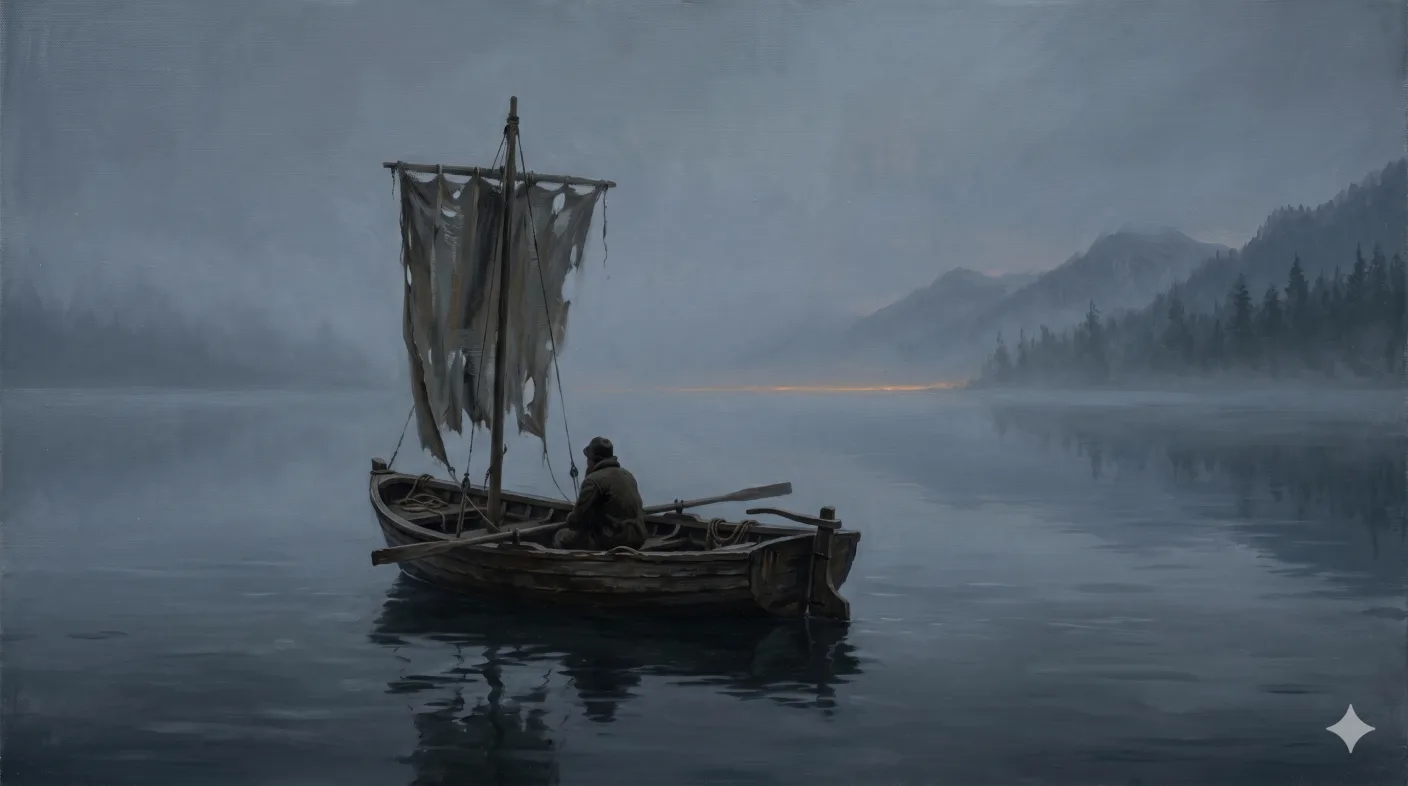
In a way, I feel like a sailor on a ship without a captain or wind in the sails, just adrift, hoping to find shore.
Train Dreams ends with Grainier at peace. I’m not there. And honestly, I don’t know if that peace is somewhere I can reach, or just something that comes after you’ve outlived everything you ever loved.
But the movie opens with a line I keep coming back to: the old world has been rolled up like a scroll, and yet you can still feel the echo of it. Maybe that’s all I can say right now. The world I knew is gone. The new one is shapeless and frightening. But the echo is still here. And so am I.
Go watch the movie now!