Bhuvan.Essays, notes and small websites
Notes · 468Page 15 of 16

Short things, kept in the open. A commonplace book, formerly rabbitholes.garden.

Links worth your time with a line on why, quotes, verse, half-thoughts and the occasional rant. Longer pieces live in writing. Follow along by RSS.

Verse

The day is gone by John Keats

Beautiful poem.

The day is gone, and all its sweets are gone!
Sweet voice, sweet lips, soft hand, and softer breast,
Warm breath, light whisper, tender semi-tone,
Bright eyes, accomplish’d shape, and lang’rous waist!
Faded the flower and all its budded charms,
Faded the sight of beauty from my eyes,
Faded the shape of beauty from my arms,
Faded the voice, warmth, whiteness, paradise—
Vanished unseasonably at shut of eve,
When the dusk holiday—or holinight
Of fragrant-curtain’d love begins to weave
The woof of darkness thick, for hid delight;
But, as I’ve read love’s missal through to-day,
He’ll let me sleep, seeing I fast and pray.
Source.

Note

Zero Sum thinking is ruining the world

This tweet thread by Jake resonated deeply with me. We all seem to be becoming increasingly adversarial in how we think about the world, and that’s not a good thing:

The deepest divide in today’s world, whether in economics, politics, investing, or even religion, seems to come down to those who view society as a zero-sum game and those who believe in shared growth. This is increasingly showing up everywhere, from relatively benign issues like tariffs and tax policy to more consequential debates over social rights and aid (and even territorial ambitions). Decisions being made seem shaped by a mindset that there needs to be a winner and loser over collective progress… at the expense of longstanding norms and values.

And

If you see the world as zero sum, you end up resenting people who are different from you or who enter your space (whether in the economy, schools, or country) because you view them as an opponent and their presence as a direct cost to yourself.

Note

I got some links for you

The human brain isn’t built to process numbers about China: Today China’s share of global export containers is over 36%, though the country represents around a fifth of world GDP. A foreign-business boss in China foresees a reckoning: “There will come a point in time when China and the world simply cannot absorb more…

Read the note →
Note

Kafka on reading

Amen. Amen a 100 times!

“I think we ought to read only the kind of books that wound or stab us. If the book we’re reading doesn’t wake us up with a blow to the head, what are we reading for? So that it will make us happy, as you write? Good Lord, we would be happy precisely if we had no books, and the kind of books that make us happy are the kind we could write ourselves if we had to. But we need books that affect us like a disaster, that grieve us deeply, like the death of someone we loved more than ourselves, like being banished into forests far from everyone, like a suicide. A book must be the axe for the frozen sea within us. That is my belief.” ― Franz Kafka

Hat tip to @kpxas.

Also see Maria Popova.

Note

Philosophy of life and Seneca’s letters

I’ve been messing around with AI coding tools lately, and they’re so good that even someone who can’t code (me) can build actual websites. While building Paper Lanterns to collect public domain letters and essays, I stumbled across Seneca’s letters to Lucilius. First read? Meh. Thought it was just another ancient Roman philosopher trying to sound profound. But when I came back to them a few weeks later and actually paid attention, I was floored. These 2,000-year-old letters about how to live a good life are ridiculously relevant—covering everything from managing time and emotions to dealing with death and maintaining friendships.

The letters are freely available on WikiSource, but reading them there wasn’t great so I built Seneca.ink—a simple, clean site where you can actually enjoy reading these letters without the clunky interface getting in the way. If you’re curious about Stoicism but don’t want to wade through academic texts or listen to LinkedIn influencers bastardize it into “productivity hacks,” these letters are the perfect starting point.

Note

Twilight of the humans?

We’ve all seen images about the decline in the global fertility rate. Some have apocalyptic pronouncements about this, trend and predict the end of humanity, but I’ve never been convinced about the doom case. Surely this isn’t the first time this has happened in human history, and yet here we are. .png) The reason why…

Read the note →
Verse

Wild Geese by Mary Oliver

Beautiful.

You do not have to be good.
You do not have to walk on your knees
For a hundred miles through the desert, repenting.
You only have to let the soft animal of your body
love what it loves.
Tell me about despair, yours, and I will tell you mine.
Meanwhile the world goes on.
Meanwhile the sun and the clear pebbles of the rain
are moving across the landscapes,
over the prairies and the deep trees,
the mountains and the rivers.
Meanwhile the wild geese, high in the clean blue air,
are heading home again.
Whoever you are, no matter how lonely,
the world offers itself to your imagination,
calls to you like the wild geese, harsh and exciting —
over and over announcing your place
in the family of things.

Note

How Americans use AI and what they think about it

Pew published a report on how Americans use and view AI, and it’s quite interesting. Americans are much more concerned than excited about the increased use of AI in daily life, with a majority saying they want more control over how AI is used in their lives. Far larger shares say AI will erode than improve people’s…

Read the note →
Note

How long do we have left?

Google DeepMind’s Gemini and OpenAI achieved gold-medal-level performance at the 2025 International Collegiate Programming Contest (ICPC) World Finals. OpenAI’s Mostafa Rohaninejad: We officially competed in the onsite AI track of the ICPC, with the same 5-hour time limit to solve all twelve problems, submitting to the…

Read the note →
Note

Today in learning

The Swiss central bank has massive equity holdings. The Swiss National Bank has US equity holdings amounting to $167bn, spread across more than 2,300 positions, according to SEC filings from June. The DeepSeek hype was manufactured? TL;DR: DeepSeek’s record-breaking hype wasn’t organic — it was powered by thousands of…

Read the note →
Verse

The Second Coming by William Butler Yeats

Damn. What a powerful poem. If there was ever a poem for the present moment. Turning and turning in the widening gyre The falcon cannot hear the falconer; Things fall apart; the centre cannot hold; Mere anarchy is loosed upon the world, The blood-dimmed tide is loosed, and everywhere The ceremony of innocence is…

Read the note →
Note

We are borrowed stardust

The ease with which Maria Popova strings together words of lyrical rhythm and immense depth is striking.

I thought of Einstein, who at sixteen, lonely and introverted, began wondering about the nature of the universe by imagining himself chasing a beam of light through outer space; I thought of the poet Rainer Maria Rilke, also lonely and also dedicated to the light, who at the same time was formulating his general theory of love as “two solitudes that protect, border, and greet each other.” And I thought about how love is simply the solitary light between people, neither partitioned nor merged but shared, to light up the sliver of spacetime we have each been allotted before returning our borrowed stardust to the universe.

Note

Philosophy understood as a way of life

This is a brilliant video by Gregory Sadler. I’ve always liked the thought that philosophy began as a way of learning how to live well. A few things that stood out to me in the video: Hadot isn’t saying philosophy-as-life disappeared after antiquity and medieval times, leaving only professors in universities. He notes…

Read the note →
Note

The economics of tyranny

From this article in the Foreign Affairs: Bukele has forced Salvadorans to trade civil liberties for a sense of security, a bargain that has only grown starker over his five years as president. But whether this arrangement lasts depends on whether it can evolve into a sustainable model of governance, which, given…

Read the note →
Note

A hopeful view of large language models (LLM)

File this under hopeful naïveté, naïve idiocy, or pointlessly hopeless romanticism. I was playing around with Gemini’s new image model, NanoBanana, and I was shocked at how good it was. That got me thinking about the present state of AI tools—by which I mean large language models (LLMs). People often use “AI” to mean…

Read the note →
Note

Social media is a funhouse mirror

Is social media a net positive or negative for society? This is an interesting question, at least for me personally, and my answer keeps changing with each passing month. You can find opinions across the spectrum. Here’s what Noah Smith tweeted, quoting the graphic below: Social media is destroying our civilization.…

Read the note →
Note

The solar revolution

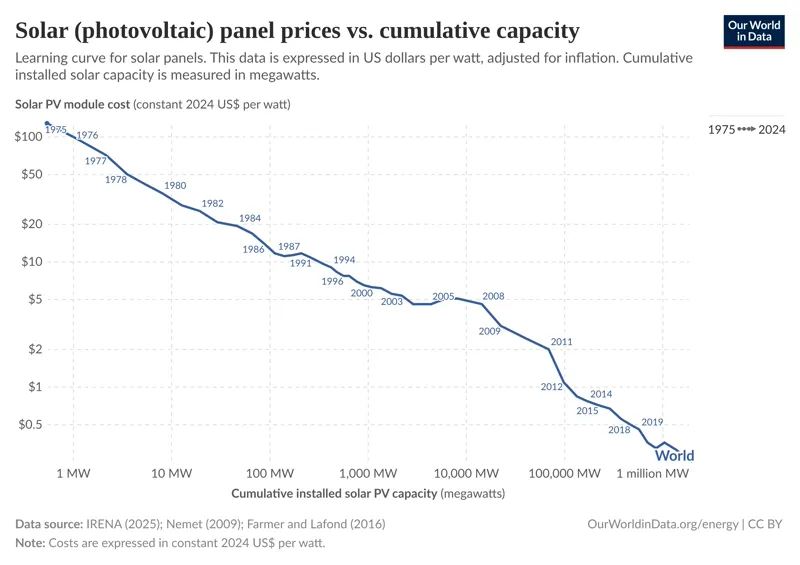
Glenn on Twitter said:

Hot take: Solar “scaling laws” will ultimately prove more impactful on humanity than the AI version

I agree.

Image: Our World in Data

Cheap solar is, in my humble view, one of the most underappreciated innovations in the recent past. I think it will prove to more consequential to humanity than most people assume.

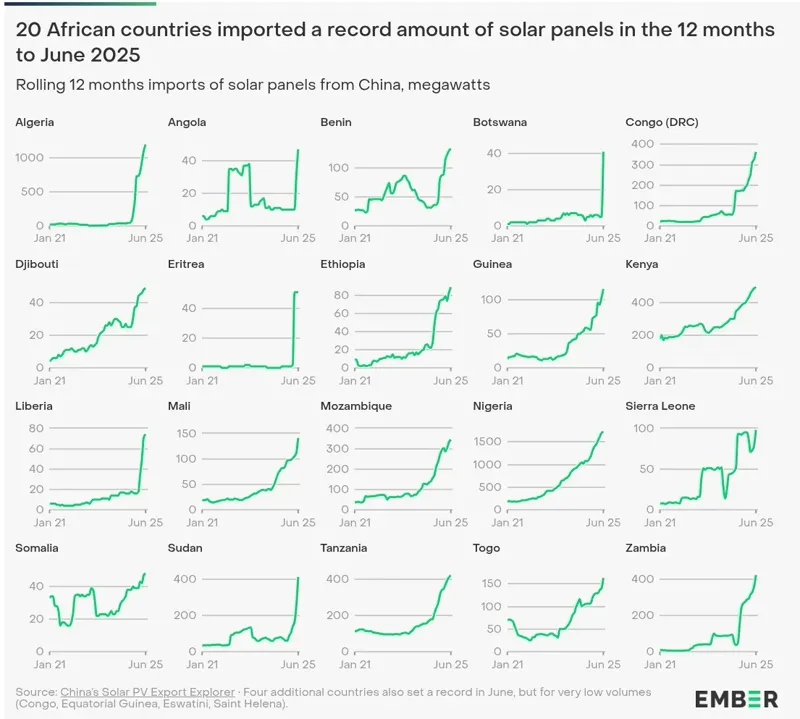
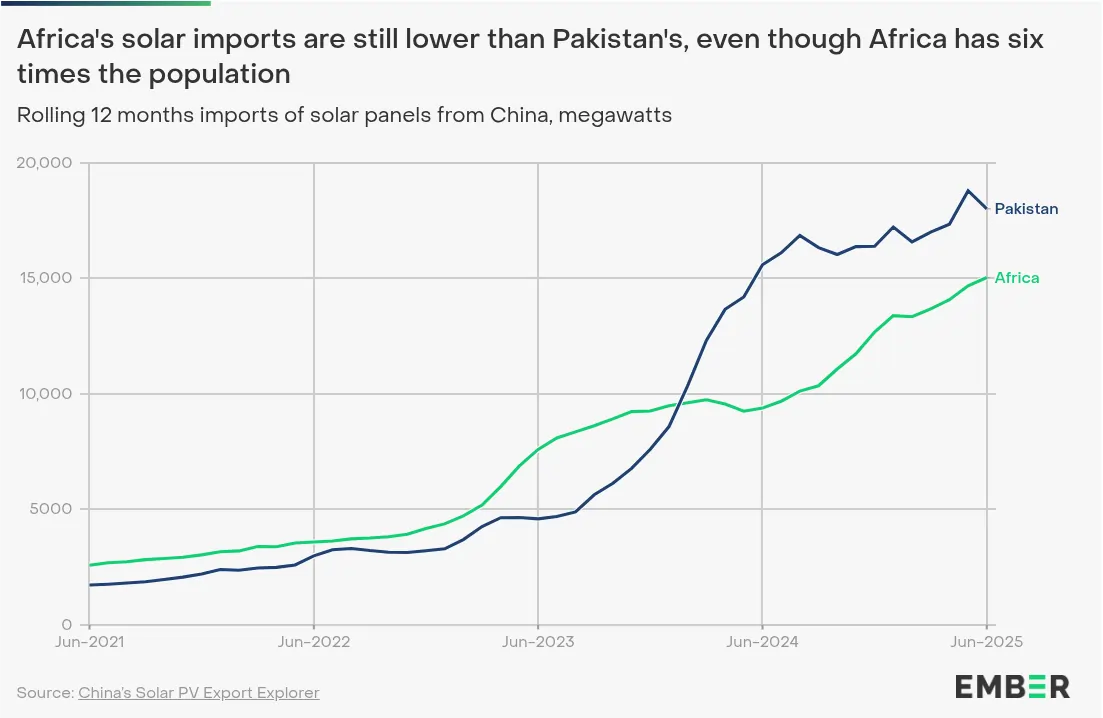
While there is a loud debate about overcapacity among Chinese solar panel manufacturers, I think it’s a good problem to have. Look the spectacular increase in the import of Chinese solar panels by African countries. I’m pretty sure all these countries would love more overcapacity and, by extension, cheap prices.

Africa’s solar imports—charts from Ember.

China is the best thing to have happened to the green transition. There is no green transition without China!

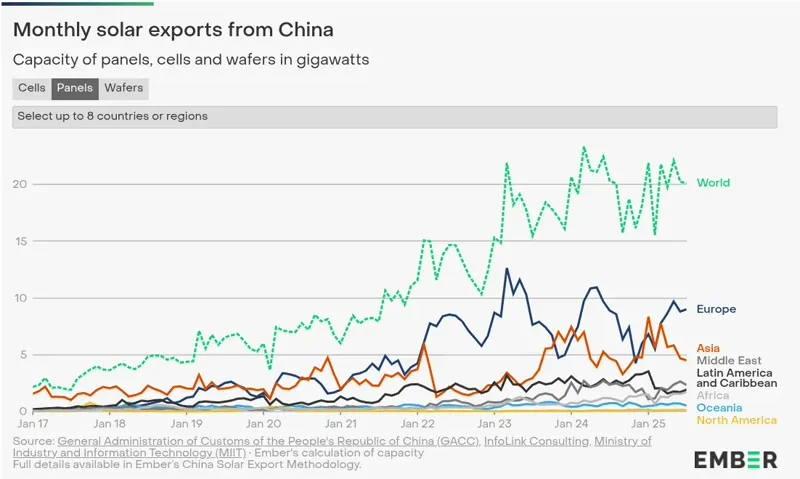
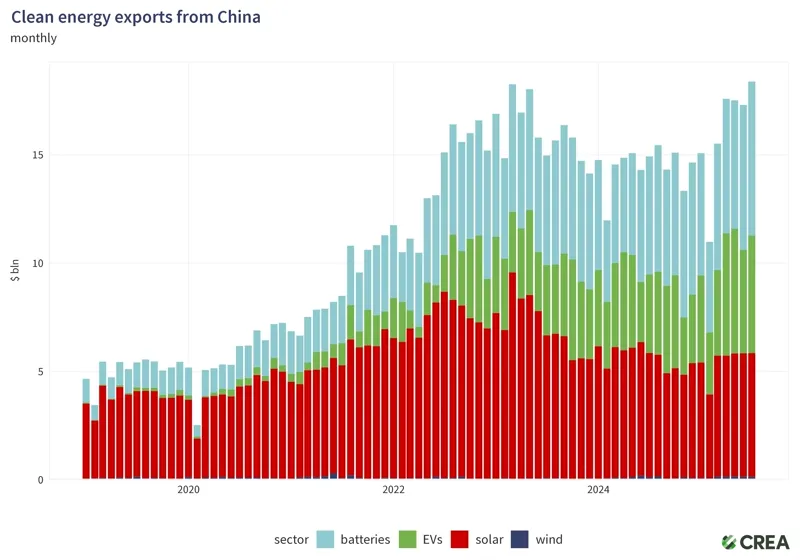
Image: Ember Energy

Another way of visualizing this.

Verse

Poetry is a salve for the soul

A beautiful perspective on what poetry can do for us by Leila Chatti: I have always put my faith in poetry, have come to it for answers. (I have never understood the shame, in poets, in admitting this.) And there was no one else, then, to turn to—the world closed, I lived inside a room of books. This is not metaphor.…

Read the note →
Note

I got some links for you

File under US-China tech cold war. Anthropic to stop selling services to Chinese companies: The policy, which takes effect immediately, will potentially apply to Chinese companies from ByteDance and Tencent to Alibaba. “We are taking action to close a loophole that allows Chinese companies to access frontier AI,” said…

Read the note →
Note

How fiber optic cables work

Think of a fiber optic cable as a super-thin strand of glass (about as thin as a human hair) that carries information using light instead of electricity. It’s like a tiny, flexible glass tube that light can travel through.

Read the note →
Note

What is artificial intelligence (AI)?

Benedict Evans is one of the most thoughtful writers on technology. Whenever I listen to him, I end up feeling embarrassed, because I keep thinking: why can’t I think like that? 😬 Unlike many other commentators, Ben has a very practical and measured view of AI. One thing I love is how he goes about defining what AI…

Read the note →
Note

Bhuvan’s law

I was listening to a conversation between Jack Clarke, co-founder of Anthropic, and Tyler Cowen. It was an interesting conversation with some interesting things that made me go, “Ooh, that’s interesting,” and a lot of vague, hand-wavy, speculative predictions that are unknowable, unprovable, and hard to mentally…

Read the note →
Note

Will the poor countries catch up the rich?

Came across this fascinating paper looking at whether developing countries are catching up to advanced countries. It’s frankly depressing, but I asked Claude for a summary. ### What Remains of Cross-Country Convergence? A Critical Review of 50 Years of Economic Growth Research. Summary by Claude. This comprehensive…

Read the note →
Verse

The heart wants what it wants

I learned that the famous line “The heart wants what it wants” is from a famous letter by Emily Dickinson and not Woody Allen.

The full line:

Dear Mary -

When the Best is gone - I know that other things are not of consequence - The Heart wants what it wants - or else it does not care -

You wonder why I write - so - Because I cannot help - I like to have you know some care - so when your life gets faint for it’s other life - you can lean on us - We wont break, Mary. We look very small - but the Reed can carry weight.

Read the letter here.

Woody Allen ruined this quote for everyone. Dickinson deserves it back.

paperlanterns.ink ↗
Note

Vibe Physics? Not Yet

Sabine Hossenfelder tried to “vibe physics” using popular LLM models, and she was underwhelmed. So if you’re a physicist, I guess your job is safe for now. I’m not a physicist myself, and I couldn’t understand half the things Sabine said. That said, she points out that the current crop of LLMs are good at literature…

Read the note →
Note

The weight of telling stories

I watched this conversation between Dave Chappelle and Mo Amer and got really thinking about what artists are supposed to do. Mo’s Netflix show Mo is about Palestinian refugees, and he literally finished writing it right before October 7th happened. Hearing him talk about navigating that timing as one of the few Palestinians in Hollywood made me appreciate how hard it is to be an artist dealing with heavy, real-world stuff. I loved their discussion about how you know when a story or joke is worth telling—basically, if it makes people laugh, think, or feel something. Both of them talked about just “calling it like you see it,” even when it’s risky.

Read the note →
Note

I just want to know

Sometimes, the most important discoveries come from simply wanting to know. This video by Betül Kaçar, “Why we explore, even when there’s no payoff,” is a beautiful reminder of the power of pure curiosity in science.

Read the note →
Note

On luck and randomness in life

A dialogue exploring one of the most fundamental tensions of the human condition: our search for meaning in a world that often seems governed by chance. We dive into the science of chaos, the psychology of storytelling, and the philosophical frameworks designed to help us navigate this profound uncertainty.

Read the note →