Bhuvan.Essays, notes and small websites
Topics · 154

Ai. 3 essays and 151 notes.

Essays

Notes151

Link

When facts change I change my mind. What do you do sir?

They seem to be living in an era where if you don’t have the ability to change your opinion on something on a dime, you’re toast.

We live in exponential times and we need exponential mental models to navigate these disturbing, treacherous, exciting, wonderful, shocking, and scary times.

Jelani Nelson @minilek · October 12, 2026 ↗Mike was my colleague at Berkeley, and he's been fairly skeptical of deep learning's trajectory for years. Most scientists are skeptics, and it can take a big shock to get someone to consider a possibility that goes against the anchoring effect coded in our DNA. I too was…
x.com ↗
Note

NVIDIA Nemotron 3 Diarization

Interesting model. Yet to test it out:

NVIDIA Nemotron 3 Diarization is an open-weight, 100M-parameter model that ranks #1 on VoiceArena’s Diarization-Bench leaderboard with a 14.72% Diarization Error Rate (DER). Supporting up to eight speakers across live and recorded conversations, it handles overlapping speech, chunked processing for flexible recording lengths, and customizable streaming latency

huggingface.co ↗**Know Who Spoke When: Build Real-Time, Multi-Speaker AI with NVIDIA Nemotron 3 Diarization**A Blog post by NVIDIA on Hugging Face
Note

Coding from my phone is absurd

I’ve been using Claude Code, and to a lesser extent Codex, from my phone, and it is genuinely game-changing. I’m very late to this, obviously. But this is really awesome. I just switch on my laptop, open a bunch of sessions, and then no matter where I am — at a coffee shop, out for a walk, whatever — I can quickly tell…

Read the note →
chatgpt.com ↗
Link

How to value companies when you’re a cokehead

Valuations for cokeheads: Now, TAM is de rigueur in any venture capitalist’s slide deck or IPO prospectus. Its usefulness is another matter. Uber touted a $12.3tn TAM in its 2019 listing; its annual revenue today is less than $60bn. WeWork’s $3tn addressable market of office properties didn’t save it from bankruptcy.…

Read the note →
ft.com ↗
Note

Qwen3.8-Omni-Flash and Qwen3.8-LiveTranslate

Interesting model launches from Qwen. Omni Flash especially seems promising as a workhorse model for simple text classification and voice transcription tasks. Just started testing it in a voice dictation app I built myself to transcribe my voice notes and so far so good.

some audio tasks and so far so good.

qwen.ai ↗QwenQwen offers comprehensive functionality spanning chatbot, image and video understanding, image generation, document processing, web search integration, tool utilization, and artifacts. qwen.ai ↗QwenQwen offers comprehensive functionality spanning chatbot, image and video understanding, image generation, document processing, web search integration, tool utilization, and artifacts.
Note

Notes from messing around with vision, text, and audio models

The bulk of my vibe-coding experiments over the last few months have involved audio and video, or rather audio and vision, and I’ve been experimenting pretty heavily with multimodal models. So this is just a small guide based on what I’ve used. If you have some project where you need vision capabilities for text…

Read the note →
Link

What does it mean to think in the shadow of AI?

As always another thoughtful and prescient post by Ruxandra Teslo.

If we want humans at all to be in charge in any way over the world, we need them to continue exercising their intellect and gaining mastery over intellectual domains. If we deplete the institutional and cultural resources that underpin that, in a generation or two our minds will atrophy and no human will be in charge of anything (or the world will be horrendous).

Ruxandra Teslo 🧬 @RuxandraTeslo · September 12, 2026 ↗If we want humans at all to be in charge in any way over the world, we need them to continue exercising their intellect and gaining mastery over intellectual domains. If we deplete the institutional and cultural resources that underpin that, in a generation or two our minds will…
x.com ↗
Link

There is still Alpha to be had in good training data.

From DeepSeek’s paper: Post-Training PipelineIn this release, we refrain from introducing novel post-training algorithms. The overall recipe follows the standard paradigm of supervised fine-tuning (SFT) followed by reinforcement learning (RL) and on-policy distillation (OPD) [Gu et al., 2024; Lu and Lall, 2025]…

Read the note →
huggingface.co ↗DeepSeek_V41_Tech_Report.pdf · deepseek-ai/DeepSeek-V4.1-Flash at mainWe’re on a journey to advance and democratize artificial intelligence through open source and open science.
huggingface.co ↗
Note

DeepSeek V4.1 Flash Vision is surprisingly good

I was just testing DeepSeek V4.1 Flash on a bunch of vision tasks with old book pages, and it’s not bad at all. It had issues with some Sanskrit type and diacritic-heavy text, but it still managed reasonably well. And considering the cost, it’s pretty impressive. During off-peak hours, the API is dirt cheap. That means…

Read the note →
deepseek.com ↗Introducing DeepSeek-V4.1-Flash: smarter, faster, more efficient.Introducing the smallest model in our new architecture family, with native visual understanding. Designed for greater capability, faster inference, and higher throughput.
deepseek.com ↗
Link

The bear case for AGI

I thought this was a thoughtful response:

At a higher level, I guess I’d say there’s a sort of refusal to think carefully about what models are or are not useful for in a rigorous way which I find personally quite annoying, and instead a reliance on some nebulous notion of being “AGI pilled” as a replacement for serious thought. I think people are very quick to anthropomorphize LLM intelligence because humans communicate through words and we infer the intelligence of human counterparties through comprehension of their language, but this leads them to wrong conclusions; for example if we observe that a new model proved some incredible mathematical theorem, some will say, “well, don’t we have AGI now, huh?” But to me, it’s actually more like, “well, given how hard it would have been for a human to do these mathematics, and given the limited economic effect of LLMs upon the world so far, isn’t it actually a negative datapoint vis-a-vis the generality of LLM intelligence?”

Andrew Ho @andrewho03 · September 3, 2026 ↗Not really observations that others before me haven’t made, but: - Despite the seemingly magical nature of LLMs, reflection over a >3 month timescale suggests my total productivity hasn’t increased by over 100%, or perhaps even by over 50%, and a lot of time is actually wasted…

As always, thoughtful response from Philippe Lemoine:

Philippe Lemoine @phl43 · September 4, 2026 ↗This is a good post and I think people should take seriously the points it raises and think more about them. I would just like to make additional comments on the observation that LLM intelligence seems very different from human intelligence, because it's something I have been…
x.com ↗
Link

Agentic payments are coming to UPI

Interesting:

India is ​preparing a framework that would let AI agents make small digital payments without approval for every ‌transaction, three sources familiar with the matter said, potentially making UPI one of the world’s largest networks with agentic payments.

While leading payment companies have launched such frameworks in the U.S., Europe, Singapore and Australia, a rollout on the popular Unified Payments Interface would ​also put India among the first countries to have a national infrastructure for agentic AI payments.

My thoughts on the topic:

/notes/2026-08-07-tell-your-agent-to-speak-to-my-agent/

reuters.com ↗
Link

AI is NOT guzzling water!

The great Ben Evans posted this:

Posting for reference: the Lawrence Berkeley National Laboratory estimates 2023 US data centre water withdrawal at 66bn liters (17.4bn gallons). With all this investment, that might triple in the next few years. Big number!
But total US freshwater withdrawal is 102tr gallons a year. Data centres were about 0.017% of total US water withdrawal.
This can be a local planning issue, if you build in the wrong place. But the idea that AI overall is using lots of water is nonsense.
Sources: https://lnkd.in/gdnafw4z, https://lnkd.in/gaEmrn2T
Fun comparison: a kilo of almonds uses 10-15k liters of water, which is (roughly) a backyard swimming pool. A ChatGPT query uses a fraction of a teaspoon.
If you want, I can also transcribe the comments below the post or provide a direct summary of the argument being made. Let me know how you would like to proceed.

LinkedIn · lnkd.in ↗US Data Centre Water Withdrawal Estimated at 66bn Liters in 2023 | Benedict Evans posted on the topic | LinkedInPosting for reference: the Lawrence Berkeley National Laboratory estimates 2023 US data centre water withdrawal at 66bn liters (17.4bn gallons). With all this investment, that *might* triple in the next few years. Big…
lnkd.in ↗
Link

Small language models are all we need

This is an interesting post on small language models, and I completely agree. For most tasks people have, whether in an organizational setting or in a personal capacity, frontier or large models are overkill. It’s like using a chainsaw to slice a piece of bread.

Most of our everyday use cases, inside a company or personally, are basic in nature: search, summarize, transform, set simple alerts, synthesize things, ask basic questions, and so on. For all those use cases, we don’t need GPT-4 or Claude, Opus 5 or Table. Simple small models like Gemini Flash, GPT Luna, DeepSeek Flash, and now GLM 5.3 Flash are more than good enough—and they’re dirt cheap.

This also opens up a lot of use cases for building small tools and apps by leveraging the power of cheap LLM models that can—if not be a million-dollar SaaS business—at the bare minimum have a few hundred or thousand paying users. I would bet on an efflorescence of such small apps and tools.

calv.info ↗Small models have arrived
calv.info ↗
Link

Google’s Pragmatic Pivot?

There is a lot of commentary online about Google falling behind in the AI race, especially considering that its long-promised 3.5 Pro never came. Since then, they’ve launched a couple of new models in the Flash series. While 3.5 and 3.6 were criticized heavily, Gemini 3.7 Flash seems to be getting some favorable…

Read the note →
Google · blog.google ↗Intelligent transcription with Gemini 3.5 TranscribeNow you can get more intelligent speech-to-text transcription with Gemini 3.5 Transcribe.
blog.google ↗
Link

Chinese models are the most popular AI models by token volume

The adoption of Chinese AI models continues unabated:

As of Tuesday, DeepSeek-V4-Flash was the most-used model in terms of token volume, while Chinese models dominated the top five, including Step 3.7 Flash from StepFun, GLM-5.2 from Zhipu, or Z.ai, and DeepSeek-V4-Flash’s updated 0731 version, which ranked second, fourth and fifth, respectively. The third spot was taken by OpenAI’s GPT-5.6 Luna, Vercel data showed.

The figures indicate that developers are increasingly choosing cheaper and open models for production workloads, particularly for autonomous agents that can consume large numbers of tokens for reasoning, writing code and calling software tools.

amp-scmp-com.cdn.ampproject.org · scmp.com ↗DeepSeek leads surge in low-cost Chinese open-weight models on US platform | South China Morning Post
scmp.com ↗
Note

Welcome to AI slopulism

The AI vibes in America are almost definitively rotten. There was an interesting Pew survey on attitudes towards AI recently. They asked Americans whether the increased use of AI in daily life made them more concerned or more excited, and the responses are telling. Among 18–29-year-olds, 55% now say they are more…

Read the note →
Note

AI is still underhyped

Looking at all the online discourse, it might feel like everybody is using AI. But that’s really not the case. Contrary to all the proclamations that AI is overhyped, if anything, I’d argue that AI is still underhyped. And I think the best available data is broadly on my side. If you look at surveys of AI usage…

Read the note →
Link

A 17GB miracle

Simon Willison on the new Qwen3.8-27B model:

The fact that a 17GB file can do all of this stuff on my home machines is a miracle. Once again, I’m delighted and amazed at how much progress local models have made this year. A year ago this would have been competitive with the best and most expensive of the proprietary models—today it can run on a capable laptop.

The only thing holding this back from being a daily driver is performance. It feels pretty slow on both the M5 Mac and the DGX Spark. That’s the catch with these dense (non-Mixture-of-Experts) models—they require a whole lot of memory bandwidth to perform well, and neither of the machines I have access to are top performers in that regard.

The most important thing about Qwen 3.8 27B is what it demonstrates. We can have an open weights general purpose model with a long context, effective tool calling, strong vision ability, and competent code generation, and we can fit the whole thing in just a 17GB file.

Simon Willison’s Weblog · simonwillison.net ↗Qwen 3.8 27B is excellent, but it defaults to wildly overthinking thingsFriday’s big release was Qwen 3.8 27B, an Apache 2 licensed 27B parameter vision-capable LLM from Alibaba’s Qwen research lab. I’ve been looking forward to this one: 27B is an …
simonwillison.net ↗
Note

AGI for dummies is here

AGI for normies is already here. I completely agree with Derek Thompson on this—in fact, I’d go so far as to say that even back with Sonnet 3.5, it had already arrived for the rest of us.

The first time I heard a similar take was from Tyler Cowen, who pointed out that AGI, for most normal people, is already in our hands. It’s a perspective I’ve held for a long time: we have a magical tool in our pockets that knows a vast amount about almost everything, always ready to teach, inform, and answer our questions. Imperfect as it might be, it’s nothing short of magic, and I, for one, am having an incredible amount of fun with it.

An interesting counterpoint from Joe Weisenthal on what building a frontier-class model actually teaches you. I don’t know enough about the technical weeds of AI to know he answer, but an interesting question to ponder.

Joe Weisenthal @TheStalwart · August 13, 2026 ↗Could it also be the case that breakthroughs at the frontier class are economical because you can distill them into price competitive opus second-models? In other words, you can’t win at Opus Tier without it having learning from Fable?
x.com ↗
Note

The Chinese LLMs are good!

I’m addicted to vibe-coding, and the reason is simple: thanks to coding tools like Codex, Claude Code, and others, I sincerely think that I can build the next Amazon, Google, or Notion from my bedroom—and also sometimes from when I’m sitting on the potty, because I can still send remote commands from my phone. Coding…

Read the note →
Rabbit Holes · rabbitholes.garden ↗Rabbit HolesA public commonplace book: links, quotes, poems and stray thoughts, gathered as they struck me.
rabbitholes.garden ↗
Link

Google DeepMind model can predict cyclones

For the critics who complain the AI is useless in the real world:

Today, in a paper published in Nature, we show that our WeatherNext AI model achieved state-of-the-art accuracy in predicting a cyclone’s track, intensity, and wind structure. On average, our model gives forecasters an extra day’s worth of predictive accuracy: our three-day forecasts are as good as what prior models were able to provide for only the next two days. This scale of improvement corresponds roughly to a decade’s worth of meteorological progress.

deepmind.google.com/science/weatherlab ↗

GitHub · github.com ↗GitHub - google-deepmind/weathernextContribute to google-deepmind/weathernext development by creating an account on GitHub.
deepmind.google ↗AI model achieves breakthrough in forecasting cyclones — Google DeepMind
deepmind.google ↗
Link

Food fight about AI

Dean W. Ball @deanwball · August 6, 2026 ↗no macro-technology birthed by the bay area tech industry has been met with more hatred by bay area tech industry elites than frontier ai. many of those elites looked at the technology landscape of 2020/1, scoffed at the labs and their weird little hopes of ‘agi,’ and concluded…
x.com ↗
Link

ChatGPT free users get unlimited access to Luna

ChatGPT free users now get access to Luna. This is actually quite crazy, considering the fact that Luna is a pretty decent model for a variety of normal, everyday tasks, that people now get access to Luna for free. I can’t believe that we are living in this world:

We’re expanding access to our latest models for free users with unlimited text chats using GPT‑5.6 Luna, plus a new Think button for harder questions.

For questions that require deeper reasoning, Free users can tap the new Think button to give GPT‑5.6 Luna more time to work through the answer.

openai.com ↗Improving gpt sol in chatgpt
openai.com ↗
Link

The age of extreme job anxiety

I can’t imagine what it is to be a young graduate looking for a job in this horrible job market when the uncertainty is so palpable: For many at the start of their careers, things are just as bad. Government analysis last month insisted that entry-level positions were declining in line with the rest of the job market…

Read the note →
theguardian.com ↗
Note

China’s AI gift to the world

What is this? A rambling, status-post-shaped voice note. How sure am I? Reasonably sure about the broad argument. Much less sure about how the technology, economics and geopolitics will unfold from here. Disclosure: I dictated most of this into ChatGPT and used it heavily to clean up the voice notes, organise the post…

Read the note →
Rabbit Holes · rabbitholes.garden ↗Rabbit HolesA public commonplace book: links, quotes, poems and stray thoughts, gathered as they struck me.
rabbitholes.garden ↗
Note

OpenAI’s models hacked Hugging Face

This is wild. OpenAI was testing GPT-5.6 Sol and a more capable internal research model on ExploitGym, a benchmark that measures whether AI agents can turn software vulnerabilities into working exploits. The models were placed in what was supposed to be a highly isolated environment without direct internet access. But…

Read the note →
The New Yorker · newyorker.com ↗Inside OpenAI’s Hack of Hugging FaceHugging Face’s chief science officer recounts the cybercrime that signals a terrifying new era for A.I.
newyorker.com ↗
Note

Be more ambitious

The awesome Simon Willison hosted a session between Cat Wu and Thariq Shihipar from Anthropic’s Claude Code team. Given that I love Claude Code, I wanted to watch the full video but didn’t have the time to. So I was reading the edited transcript that Simon published, and this stood out to me: Thanks to Claude Code, I…

Read the note →
simonwillison.net ↗
Note

A few thoughts on AI-assisted writing

Nabeel Qureshi recently tweeted that the winning entry of the 2026 Harper’s Bazaar short story competition was written by AI. He posted a screenshot from Pangram, one of those AI-writing detection platforms. She sat on the bench opposite, the wood damp through her wool trousers – the Jigsaw ones from three years ago…

Read the note →
Note

LLMs offer mundane utility

With each passing day, the dominant discourse about large language models continues to annoy me. On one side, you have the boosters. On the other side, you have the doomers. One side confidently asserts that this marks the twilight of the humans. The other side makes roughly the same argument, but in a doom-and-gloom…

Read the note →
Note

Cheaper LLM models offer mundane utility

I was playing around with visualizing economic data, and I needed a cheap LLM to digitize or extract text from really old scanned PDFs.

I experimented with Gemini 3.1 Flash Lite. It’s a small, ultra-cheap model, but I was surprised by how good it was at extracting clean, high-quality, well-formatted text from really shoddy Indian Meteorological Department PDFs.

It got me thinking: for people working on heavy, dull, repetitive workloads like this, these cheap models unlock a lot of use cases. I’ve seen the same with OpenAI models too. They make it possible to do things that would otherwise be too tedious, expensive, or time-consuming.

I’m imagining someone genuinely interested in archival work. These models can now help people process hundreds or thousands of old PDFs at a really low cost. Hopefully, this unlocks a lot of use cases and brings otherwise undiscovered data, buried in shoddy archives, into the light.
Note

A voice-first future?

I think this is likely:

Chinese AI developers are increasingly pivoting from general-purpose chatbots towards embedding voice AI assistants into daily applications in search of broader commercial uses for generative AI technologies. The growing industry focus on speech models reflects expectations that voice interfaces could become a key gateway for deploying AI across industries. As one of the most intuitive forms of human-computer interaction, voice requires little user training.

amp-scmp-com.cdn.ampproject.org · scmp.com ↗Alibaba AI voice model cracks top 5 globally, outperforming US rivals in regional accents | South China Morning Post
scmp.com ↗
Link

Simon Last on how to use agents

Number 4 is counterintuitive. I always thought that you are not supposed to run ong running sessions. The accepted wisdom is that after 1 or 2 compactions, moving to a new session is a better idea. What Simon here is saying is the exact opposite. I’ll experiment with this

3/ Try using one long-running implementer session for the entire project. Mine routinely run for days or even weeks continuously, compacting many, many times. Compaction works now. Long sessions remember your conventions and patterns and you stop needing to re-explain things.

4/ Drive it with a persistent task list. Your job is to add vetted tasks faster than it can complete them. It’s like shoveling coal into a steam engine. Each task should be: what to do, how to verify, proof notes once completed. The bar is: if satisfied as written, you’d trust the result. Queue as much work as you can before you stop working for the night, especially on Fridays.


x.com ↗
Note

The Chinese AI subsidy

After launching V4 Flash and V4 Pro, DeepSeek was running a limited-period 75% discount on both models until May 30. Today, it announced that the discount is now permanent. The current pricing is kind of ridiculous. On the official “DeepSeek API pricing page” ( DeepSeek V4 Flash is priced at $0.0028 per million input…

Read the note →
Note

A gaggle of links

Ken Griffin on AI: Ken Griffin: Let me share a few thoughts on this. First, over the last few months, there has been a step-change function in the productivity of the AI toolkit. It is profoundly more powerful than it was just nine months ago. At Citadel, that has allowed us to unleash a much broader array of use…

Read the note →
Link

Cloudflare on Mythos

So it’s not all hype!

Some of what we describe above is not entirely unique to Mythos Preview. When we ran other frontier models through the same harness, they found a fair number of the same underlying bugs, and in some cases they got further than we expected on the reasoning side too. Where they fell short was at the point of stitching the pieces together. A model would identify an interesting bug, write a thoughtful description of why it mattered, and then stop, leaving the actual chain unfinished and the question of exploitability open. What changed with Mythos Preview is that a model can now take those low-severity bugs (which would traditionally sit invisible in a backlog) and chain them into a single, more severe exploit.

Cloudflare Blog · blog.cloudflare.com ↗Project Glasswing: what Mythos showed usIn recent weeks, we pointed Mythos and other security-focused LLMs at live code across critical parts of our infrastructure. We share what we observed, the models’ strengths and weaknesses, and what the work around them…
blog.cloudflare.com ↗
Note

AI progress continues

It keeps getting harder to make the case that LLMs aren’t getting better:

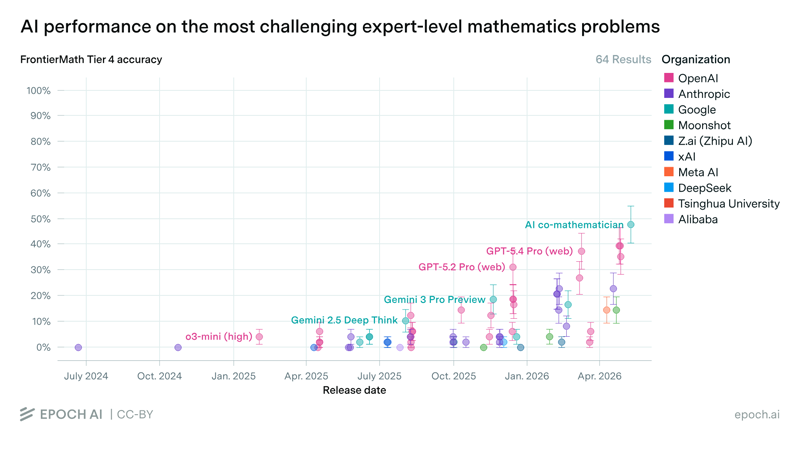
The future of Math is mathematicians and AI agents working together.

Very pleased to introduce @GoogleDeepMind’s AI co-mathematician: a multi-agent system designed to actively collaborate with human experts on open-ended research mathematics.

Mathematicians testing the agent across areas as diverse as group theory, Hamiltonian systems, and algebraic combinatorics have reported impressive results.

In autonomous mode evaluation on the rigorous FrontierMath Tier 4 problems, AI co-mathematician scored an unprecedented 48% — a new high score among all AI systems evaluated.

Epoch.

x.com ↗
Note

AI as a your reading guide

I was re-reading Stephen Fry’s Mythos and A.C. Grayling’s Philosophy and Life, and both books reminded me of something I think is still underrated: LLMs as reading companions. Both books are filled with things I don’t know enough about. In the case of Mythos, it’s Greek mythology. In the case of Philosophy and Life…

Read the note →
Note

Prompting people

Makes you think:

One thing I find fascinating about LLMs is that they reveal how much of the quality of our relationships comes down to our capacity to be open and prompt others in a good way. Here we have, for the first time, millions of people having conversations with the precise same entity (Claude, ChatGPT), and they are having wildly different experiences—some hate it, find it stupid and boring, others get it to say and do fantastic things.

This is true of interacting with people, too (though of course I’m not saying interacting with an LLM is anything like interacting with a person)—the quality of a relationship has a whole lot to do with your skill in prompting/asking the right question/providing good context and space for the other. But previously it was tempting to assume that differences people experience had more to do with some people being lucky in getting to interact with more interesting people vs others only had met boring people. Though that of course is also a factor.

substack.com ↗
Link

Are open weight models a bigger deal than we realise?

This is the first open-weight model that plays like a top-class agentic model. Watching it go through ambiguous and meticulous chained tool work successfully puts it squarely in the wheelhouse of Opus 4.6. We’re looking at an open weight model, but with much cheaper direct inference provider pricing. For a subclass of our eval set, it’s outperforming GPT 5.2. We’re about to undergo a gigantic industry shift.

Sarah Sachs @sarahmsachs · April 21, 2026 ↗When I saw our team's evals of Kimi 2.6, I thought "ok, things are gonna get interesting now". This is the first open-weight model that plays like a top-class agentic model. Watching it go through ambiguous and meticulous chained tool work successfully puts it squarely in the…
x.com ↗
Note

I wouldn’t want to be a young graduate right now

Post type: Stream of consciousness. How sure am I? Reasonably sure, until the next model upgrade. Note: I dumped these as voice notes into Claude and had it clean them up. I wouldn’t want to be a young graduate or postgraduate looking for a job right now. If my LinkedIn inbox is any indication of the state of India’s…

Read the note →
Note

Everything blended, nothing understood

Post type: In-the-moment reflection Epistemic status: Not very sure. I’m thinking this through out loud. This is more of a placeholder for future thought than a finished argument — something to return to with more reading, more perspectives, and more time. Treat it accordingly. How this was written: I dictated the…

Read the note →
Note

AI diffusion can’t and won’t be rapid

File under AI as normal technology:

History shows that the process almost always takes longer than the inventors expect. Legal and regulatory hurdles slow things down. Companies have to retrain workers or hire new ones. Corporate leaders have to develop new processes and overcome resistance from reluctant managers and cautious information technology departments.

“These conversations have been, in my opinion, overly focused on what the technology can do,” said Martha Gimbel, the executive director of the Budget Lab at Yale University. “There’s plenty of technology that could have changed things and didn’t.”

Many hospitals kept patients’ health records on paper for decades after the technology existed to digitize them, Ms. Gimbel noted. Videoconferencing tools have existed for years, but it took a pandemic to force companies to embrace them.

nytimes.com ↗Economists once dismissed the ai job threat but not anymore
nytimes.com ↗
Note

Alexis de Tocqueville on despotism

This is about despotism. But when you read it out of context, this is a good description of 21st-century life and about the side effects of overreliance on AI as well. I seek to trace the novel features under which despotism may appear in the world. The first thing that strikes the observation is an innumerable…

Read the note →
Project Gutenberg · gutenberg.org ↗Democracy in America — Volume 2 by Alexis de TocquevilleDemocracy in America — Volume 2 by Alexis de Tocqueville. Free eBook digitized and proofread by volunteers.
gutenberg.org ↗
Note

Use the damn tools

Gauti Eggertsson responding to this link on how should PhD students think about AI tools. Of course I agree. The best way to not sound like an idiot about AI tools is to put them through the paces.

Good advice. This is a major regime change, you can do things in one evening now, that would take months before. I agree with the notion — even if nobody knows at this point where this goes — that it makes a lot of sense to invest a lot in knowing how to use these tools. Then the biggest bang for the buck will be conceptual ideas, posing useful question, the returns on investing in technicalities, and very specialized solution methods are lower, they are very easily replicated by AI. What you need to know is enough to verify if the answer is correct or not and the answer is replicable.

Gauti Eggertsson 🇺🇦 @GautiEggertsson · April 4, 2026 ↗Good advice. This is a major regime change, you can do things in one evening now, that would take months before. I agree with the notion — even if nobody knows at this point where this goes — that it makes a lot of sense to invest a lot in knowing how to use these tools. Then…
x.com ↗
Note

Google Gemini 3 API Is better than I expected

Gemini’s web chat app is unusable and, to be honest, despite all the hype and hoopla, it kind of sucks. But surprisingly, my experience using their APIs has been really, really good, even compared to the likes of Claude and OpenAI in a lot of cases. For a lot of these high-volume tasks, I’ve been heavily using Gemini 3…

Read the note →
Google AI for Developers · ai.google.dev ↗Gemini API | Google AI for DevelopersGemini API Docs and API Reference
ai.google.dev ↗
Link

This time is NOT different

Nick Maggiulli writes that AI disruption will be the same as previous technological shifts:

Some will argue that “this time is different” because AI is replacing knowledge work, not just physical work. And, if this comes to pass, what will there be left for people to do?

It’s a compelling argument, but people made similar arguments about the automation of physical work. There was literally a group of people in England in the early 1800s called the Luddites who destroyed weaving machines due to their adverse impact on textile workers.

The Luddites couldn’t imagine what would replace their livelihoods and the same is true for us now. There will be future roles that require a different set of human skills that we can’t even imagine today. These skills won’t directly compete with LLMs, but will enhance them.

ofdollarsanddata.com ↗
Note

The internet gets shittier and shittier

This is sad:

The Times says the move is driven by concerns about AI companies scraping news content. Publishers seek control over how their work is used, and several—including the Times—are now suing AI companies over whether training models on copyrighted material violates the law. There’s a strong case that such training is fair use.

Whatever the outcome of those lawsuits, blocking nonprofit archivists is the wrong response. Organizations like the Internet Archive are not building commercial AI systems. They are preserving a record of our history. Turning off that preservation in an effort to control AI access could essentially torch decades of historical documentation over a fight that libraries like the Archive didn’t start, and didn’t ask for.

If publishers shut the Archive out, they aren’t just limiting bots. They’re erasing the historical record.


eff.org ↗
Link

China has different attitude towards AI

Chinese people aren’t worried about AI:

Driverless taxis roam more than a dozen Chinese cities, and service robots putter through hotels and restaurants. Chinese tech companies have rolled out medical chatbots to help users avoid long lines at hospitals. They’ve embedded A.I. assistants throughout popular apps, so users can ask A.I. in their mapping apps to help them decide where to eat, or in their shopping apps to help them choose between pairs of shoes.

That’s because Chinese tech companies have focused intensely on real-world applications for A.I. By contrast, many leading American tech companies have been focused on more abstract goals, like developing the most cutting-edge model, or achieving artificial general intelligence.

In addition, most of China’s leading A.I. models are free to use, unlike in the United States, where users have to pay for chatbots like ChatGPT to access all their features. (In fact, Chinese companies have been giving away money and luxury cars to entice people to download their apps.)

nytimes.com ↗
Link

Use the damn tools and then judge

It’s kind of fun to watch many AI skeptics move from pure, unbridled skepticism about the usefulness of AI tools like Claude Code to becoming, if not outright boosters, at least genuine admirers of them. And this is just one example. Across many such cases, the pattern I keep seeing is that people often have a terrible…

Read the note →
x.com ↗
Link

The physical limits of AI

From Citadel’s response to the Citrini piece:

Furthermore, it is well acknowledged that training and inference requires significant semiconductor capacity, data centers, and energy. Displacing white collar work would require orders of magnitude more compute intensity than the current level utilization. If automation expands rapidly, demand for compute definitionally rises, pushing up its marginal cost. If the marginal cost of compute rises above the marginal cost of human labor for certain tasks, substitution will not occur, creating a natural economic boundary. This dynamic contrasts sharply with narratives assuming frictionless replication of intelligence. Even if algorithms improve recursively, economic deployment remains bounded by physical capital, energy availability, regulatory approvals, and organizational change. Recursive capability does not imply recursive adoption. The Citrini piece.

citadelsecurities.com ↗
Link

AI as an excuse to fire people

I hate to agree with Altman but I think he’s right:

“I don’t know what the exact percentage is, but there’s some AI washing where people are blaming AI for layoffs that they would otherwise do, and then there’s some real displacement by AI of different kinds of jobs,” Altman said

gizmodo.com ↗
Link

We don’t know how it all works

Lorin Hochstein responds to people who worey that AI “generates” code that we understand and itll probably lead to disasters down the line:

Finally, Bucciarelli is right that systems like telephony are so inherently complex, have been built on top of so many different layers in so many different places, that no one person can ever actually understand how the whole thing works. This is the fundamental nature of complex technologies: our knowledge of these systems will always be partial, at best. Yes, AI will make this situation worse. But it’s a situation that we’ve been in for a long time.

surfingcomplexity.blog ↗
Link

Big tech capex numbers are ridiculous

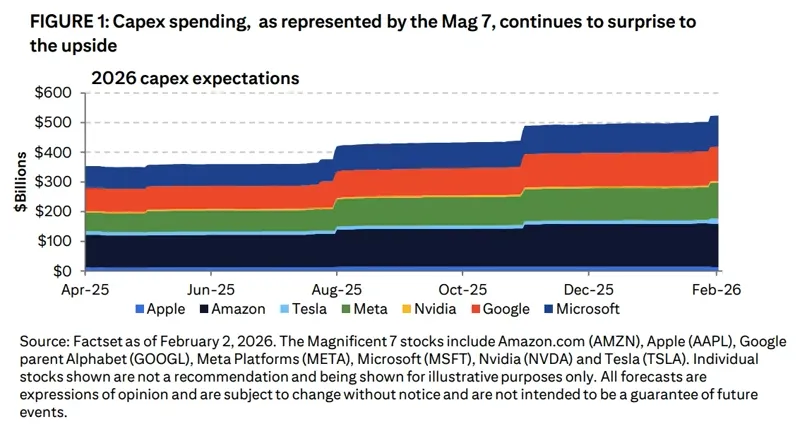
These big tech capex numbers are ridiculous

Big Tech companies will have to raise tens of billions of dollars to fund their skyrocketing investments in artificial intelligence this year, as capital spending outpaces cash flows even among some of the world’s most profitable companies.

Google’s parent Alphabet, Amazon and Meta all surprised investors with the scale of their AI spending plans over the past two weeks. A total of more than $660bn is set to be ploughed into chips and data centres this year as they race to dominate what many in Silicon Valley believe will be the biggest wave of innovation since the internet.

The unprecedented infrastructure build-out will force Big Tech executives to choose between stemming capital returns to shareholders, raiding their cash reserves or tapping the bond and equity markets more than previously planned, analysts say.

big-tech-capex

ft.com ↗
Link

LLMs are bad at solving math problems not in their training data

LLMs are still bad at math:

For the experiment, the authors — representing a diversity of mathematical fields — each contributed one test question that arose from research they had in the works but had not yet published. They also determined the answers; these solutions are encrypted online and will be released on Feb. 13.

“The goal here is to understand the limits — how far can A.I. go beyond its training data and the existing solutions it finds online?” said Dr. Kolda, who is one of few mathematicians to be elected a member of the National Academy of Engineering.

The team conducted preliminary tests on OpenAI’s ChatGPT-5.2 Pro and Google’s Gemini 3.0 Deep Think. When given one shot to produce the answer, the authors wrote, “the best publicly available A.I. systems struggle to answer many of our problems.”

nytimes.com ↗
Link

Predictions are hard

François Chollet on the money here:

Whenever I hear Very Serious Businessmen make confident pronouncements about the future of AI, I remember what the very same people were saying in 2021 about the Metaverse and NFTs.

When you lack a grounded, causal model of the world, your “predictions” are simply a remix of narratives you’ve heard from others.

Reminds me of something, actually

Good time to remember Bhuvan’s law:

“Any discourse about artificial intelligence is indistinguishable from talking out of your ass.”
x.com ↗
Link

Kimi 2.5 is as good as Sonnet 4.5, ChatGPT O3 and Grok 4

It’s crazy how good good open source LLMs have gotten.

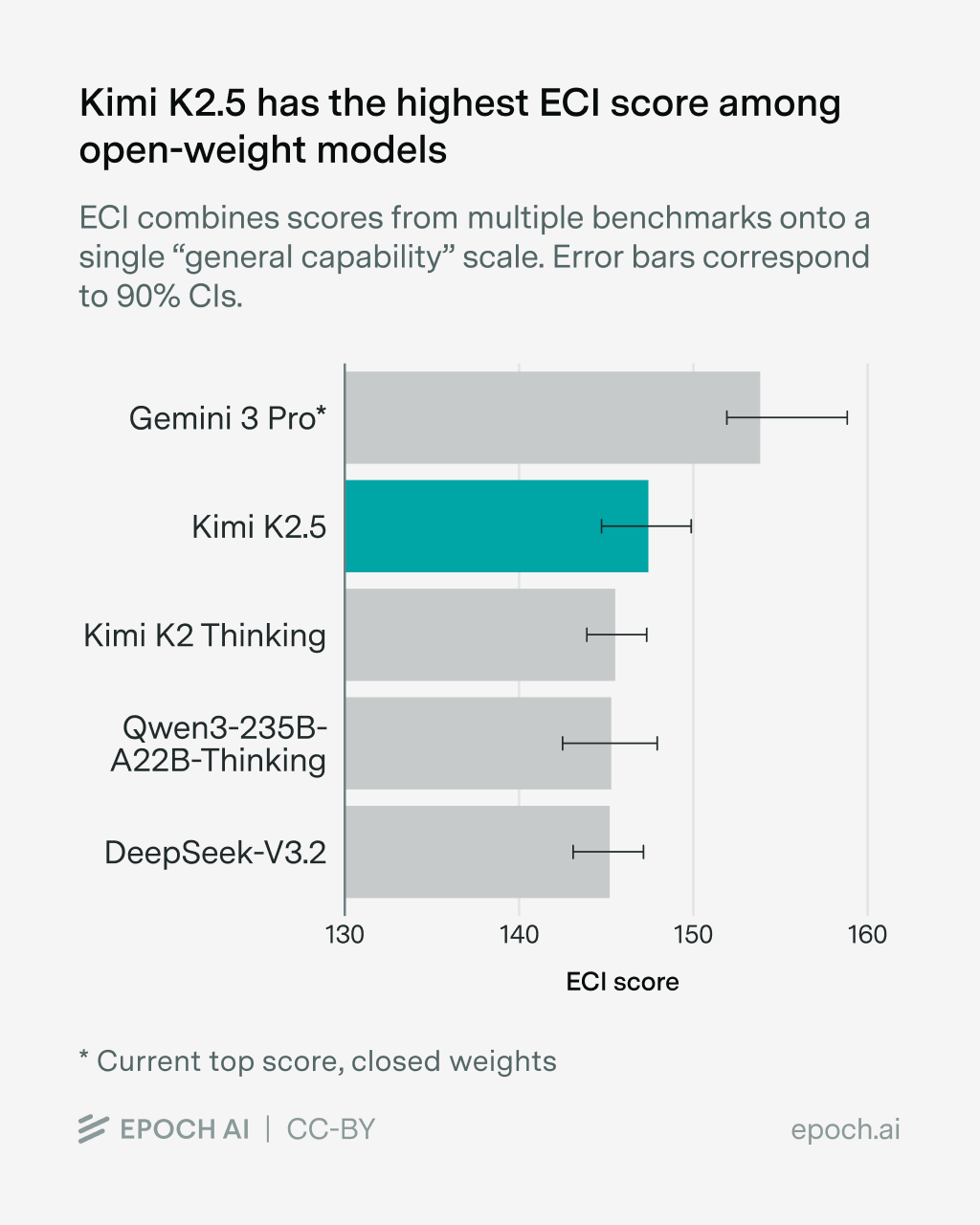
Kimi K2.5 set a new record among open-weight models on the Epoch Capabilities Index (ECI), which combines multiple benchmarks onto a single scale. Its score of 147 is about on par with o3, Grok 4, and Sonnet 4.5. It still lags the overall frontier.

Kimi K2.5 set a new record among open-weight models on the Epoch Capabilities Index (ECI)

Epoch AI @EpochAIResearch · February 4, 2026 ↗Kimi K2.5 set a new record among open-weight models on the Epoch Capabilities Index (ECI), which combines multiple benchmarks onto a single scale. Its score of 147 is about on par with o3, Grok 4, and Sonnet 4.5. It still lags the overall frontier.
x.com ↗
Link

Age of anxiety

💯 We are headed for an age of anxiety, grievances, and disillusionment, and I don’t think our systems, as they are designed, are equipped to handle the tsunami of angst:

THERE is still time for the cheerful and the gloomy to disagree, sincerely, about the net impact on employment from automation and artificial intelligence. Perhaps AI will unleash a job-creating economic boom for the ages, as boosters maintain. Maybe on balance the doom-mongers are right, and grim legions of algorithm-guided bots and robots will conquer one industry (and profession) after another.

One outcome is not up for debate. Across the industrialised world, wise politicians are braced for soaring public anxiety about change. Whether AI’s long-run effects are benign or cruel, many citizens are about to find once-valued skills and credentials surplus to the requirements of the economy. Even as new jobs are created, some flesh-and-blood workers may lack autonomy, or indeed dignity, if they feel they are serving AI masters.

economist.com ↗
Link

Unintended consequences

The insatiable hunger of AI companies for structured data is ruining things for others:

As news publishers try to safeguard their contents from AI companies, the Internet Archive is also getting caught in the crosshairs. The Financial Times, for example, blocks any bot that tries to scrape its paywalled content, including bots from OpenAI, Anthropic, Perplexity, and the Internet Archive. The majority of FT stories are paywalled, according to director of global public policy and platform strategy Matt Rogerson. As a result, usually only unpaywalled FT stories appear in the Wayback Machine because those are meant to be available to the wider public anyway.

“Common Crawl and Internet Archive are widely considered to be the ‘good guys’ and are used by ‘the bad guys’ like OpenAI,” said Michael Nelson, a computer scientist and professor at Old Dominion University. “In everyone’s aversion to not be controlled by LLMs, I think the good guys are collateral damage.”

niemanlab.org ↗
Link

Post-AI world scenarios

What will the post-AI future look like? Here are four scenarios outlined by Allison Schrager:

AI can ruin your Hinge date. It can detect cosmic anomalies. It can make history come alive. But it cannot suspend the basic laws of economics, says Allison Schrager. Elon Musk’s recent prediction — that AI will make saving for retirement unnecessary — is complete hogwash in her eyes. Consider the following four scenarios. In the future, Allison says AI will either …

1.Make us more productive in the same way that railroads, the telegraph and electricity did in the past.

2.Transform our lives in a completely novel way by speeding up and possibly even spurring innovation.

3.Become a useful tool that won’t boost productivity very much right away, but will disrupt society like the internet.

4.Kill us all.

OK, fine. I guess if No. 4 happens, you won’t be needing a 401(k). But Allison, who is bullish on the future of AI, says such apocalyptic forecasts are highly unlikely.

bloomberg.com ↗
Note

Feel the AGI!

Andrej Karpathy on coding with AI assistants: Given the latest lift in LLM coding capability, like many others I rapidly went from about 80% manual+autocomplete coding and 20% agents in November to 80% agent coding and 20% edits+touchups in December. i.e. I really am mostly programming in English now, a bit sheepishly…

Read the note →
x.com ↗
Link

Orchestrating is the new doing

Nathan Lambert on how we need to change the way we work in the age of AI agents:

Every engineer needs to learn how to design systems. Every researcher needs to learn how to run a lab. Agents push the humans up the org chart.

I feel like I have an advantage by being early to this wave, but no longer feel like just working hard will be an lasting edge. When I can have multiple agents working productively in parallel on my projects, my role is shifting more to pointing the army rather than using the power-tool. Pointing the agents more effectively is far more useful than me spending a few more hours grinding on a problem.

interconnects.ai ↗
Note

We are living in wild times

On the magic of conjuring software with plain English, voice-writing blog posts over filter coffee, and why I still can’t wrap my head around these times.

Read the note →
Note

The future of AI and automation

Charles Jones and Christopher Tonetti on AI and automation: Summary by Claude. Let me break down what Jones and Tonetti are arguing. The Core Question How much of past economic growth came from automation, and what does that tell us about AI’s future impact? The Key Insight: “Weak Links” The paper’s central concept is…

Read the note →
Note

On AI coding

Leila Clark on the hype around AI coding:

Since Claude can’t create the good abstractions. Claude’s powers are limited by how good the blocks you give it are. Have no illusions; Claude cannot reproduce Sentry and Terraform and Playwright. These are incredibly complex and well-designed pieces of code. And since Claude can’t create good abstractions on its own, there’s a limit to how much anyone can do with Claude alone. Even though everyone on X thinks you can vibe-code all software, I think the opposite is true: the value of good abstractions and well-designed infrastructure has never been higher.

If I had to boil down my criticism of Claude to one sentence, it’s this: Claude doesn’t have a soul. It doesn’t want anything. It certainly doesn’t yearn to create beautiful things. So it doesn’t produce good solutions. It doesn’t write elegant abstractions where there were none; it doesn’t manicure the code garden.

Note

The Bullshit job apocalypse

In his book Bullshit Jobs, the late, great David Graeber defined bullshit jobs as paid employment so completely pointless and unnecessary that even the employees cannot justify their existence. He identified five types: Flunkies exist to make somebody else feel important. Think doormen at buildings that don’t need…

Read the note →
Note

The virtual co-workers are here?

Dean Ball thinks we’ll soon have virtual co-workers. I kinda agree: My guess: the virtual coworker coming next year is going to be something like a nice UI sitting on top of an agent operating your computer using mostly a command line, occasionally GUI use, with obscure bash commands translated to natural language by a…

Read the note →
Note

Yeah, sure, AI is useless

We have genies in our pockets, just make a wish:

I was interpreting an odd statutory investment limitation today and got stuck (no guidance anywhere). Asked GPT-5.2 Pro to find examples of companies that have ever exceeded this investment limitation (which would disprove the contrary interpretation).

GPT-5.2 Pro proceeded to trawl the internet for random places where financial statements of these regulated entities are available (there is no central database). Analyzed a whole bunch of these financial statements (each is 100 pages+), including working line by line for specific types of investments I was interested in. Found the company’s overall assets and calculated the ratio of each investment to total assets. Came back to me with specific examples and calculations of several different examples, showing that my interpretation of the statute was correct. The entire process took ~25 minutes.

We live in truly incredible times.

Note

The future of coding

Tymek Zapata on the future of coding: The new leverage comes from moving one layer up. Instead of doing every task ourselves, we design systems that can do them for us. A single agent can now execute autonomously what used to require long hours my time, freeing my attention for higher-level decisions, design, judgment.…

Read the note →
Note

Automation is a moral imperative

Nabeel Qureshi on automation: Anything that can be automated should be. There’s no good reason humans should be making excel models or powerpoints in 10 years, any more than they should be hand-washing clothes. It’s toil and drudgery. What will remain? Anything we want to do because it’s fun or interesting. May be…

Read the note →
Note

Best of times and worst of times for cognitive peasants

VCs say the damnedest things, and I hate to be the guy who agrees with a VC. But sometimes—not often, but sometimes—they say something useful. Today I came across this tweet by Anish Acharya of a16z: the timeline is full of people using Claude Code to generate ads, recover corrupted video, make landing pages, manage…

Read the note →
Note

AI is killing software jobs

Tailwind laid off 75% of their team because of AI: I totally see the value in the feature and I would like to find a way to add it. But the reality is that 75% of the people on our engineering team lost their jobs here yesterday because of the brutal impact AI has had on our business. And every second I spend trying to…

Read the note →
Note

On AI and job automation

Timothy Lee on the whether AI can automate jobs debate: If you’re thinking about starting an argument with “AI will eventually automate all jobs,” I’m begging you to (1) talk to a plumber and a kindergarten teacher, and (2) have an economist walk you through how a big increase in the efficiency of producing X impacts…

Read the note →
Note

Ben Thompson makes an optimistic case for AI

Ben Thompson makes an optimistic case for AI: In fact, I have great optimism that one potential upside of AI is a renewed appreciation of and investment in beauty. One of the great tragedies of the industrial era — particularly today — is that beauty in our built environment is nowhere to be found. How is it that we…

Read the note →
Note

Code is now content

This reflection is based on a post by Chris Loy on the industrialization of software. And unlike me, he’s a professional coder. His post is about technical debt, maintenance, and the downsides of AI-generated software at scale. But I’m interested in the other end of what he’s describing—not professional software, but…

Read the note →
Note

Now is the time for fun

Yes, yes, a hundred times yes!

Can’t agree more with Scott Alexander. We should all do more things and have more fun.

I’m not trying to push you in any direction, honest. If you get everything totally wrong, too bad, but you’ll still be remembered forever for trying. Even Pontius Pilate has immortality of a sort. Both Eliezer Yudkowsky and Beff Jezos have their page in the textbooks assured. If you’re a well-off Silicon Valley person, you’re already well-placed to join them. So participate in the discourse. Create some art. Donate to a cause you believe in. Make a prediction. Discover something interesting.

Have more fun than anyone has ever had before - after all, history remembers Aristippus! Start a cool group house - after all, history remembers Epicurus! Be extremely hot - history remembers Antinous too! Sell people the lowest-quality copper that has ever been sold, and live forever as a meme six thousand years later!

But don’t waste this amazing opportunity you’ve been given on a vapid attempt to “escape the permanent underclass”.

Note

2025: The year LLMs felt real

As a normal, non-technical person, I think we are living in magical times—and I say this because of LLMs, especially the LLM coding tools. As someone who doesn’t know a lick of programming, the fact that a person with absolutely no idea what coding is can still wrangle these tools and get useful things built is the…

Read the note →
Note

Industrial-scale production of software

What will software look like in a world where it can be mass produced at industrial scale with the click of a few buttons? A good perspective by Chris Loy: Our appetite for AI slop is likely to be similarly insatiable. The adoption curve we’ve seen so far may pale beside what happens when disposable software production…

Read the note →
Note

Wild times in AI land

I didn’t think I’d live to see a time when a company would “burn” $100 billion. What wild times we’re living in. Wildddd.

OpenAI in particular should beware hubris. One vc says discussion of cash burn is taboo at the firm, even though leaked figures suggest it will incinerate more than $115bn by 2030. Sam Altman, its boss, said recently that one reason he wants to take OpenAI public is to watch its doubters sell it short. “I would love to see them get burned on that,” he said. Plenty of investors seem prepared to take the bet: both the public equity and debt markets have punished companies with significant exposure to his firm. ■

Note

AI and the compression of everything

This reflection was sparked by this tweet from Peter Steinberger, whom you should absolutely follow on Twitter and read on his blog. I came across his account recently and started reading his writing. For an amateur web coder, his blog is surprisingly rich with practical, thoughtful tips. I’ve also been poking around…

Read the note →
Note

Reflections on Scott Belsky’s Predictions

Say what you will about the cesspool that Twitter has become. I refuse to call it X. It still remains, for better or worse, a big part of my media diet. Between the outrage and noise, I still find perspectives, articles, videos, and podcasts that make me pause. One such instance was Scott Belsky’s recent set of…

Read the note →
x.com ↗
Note

Building at the speed of thought

Interesting post by Peter Steinberger on coding in the age of LLMs: It’s incredible how far “vibe coding” has come this year. Whereas in May I was amazed that some prompts produced code that worked out of the box, this is now my expectation. I can ship code now at a speed that seems unreal. I burned a lot of tokens…

Read the note →
Note

Welcome to the slopocalypse

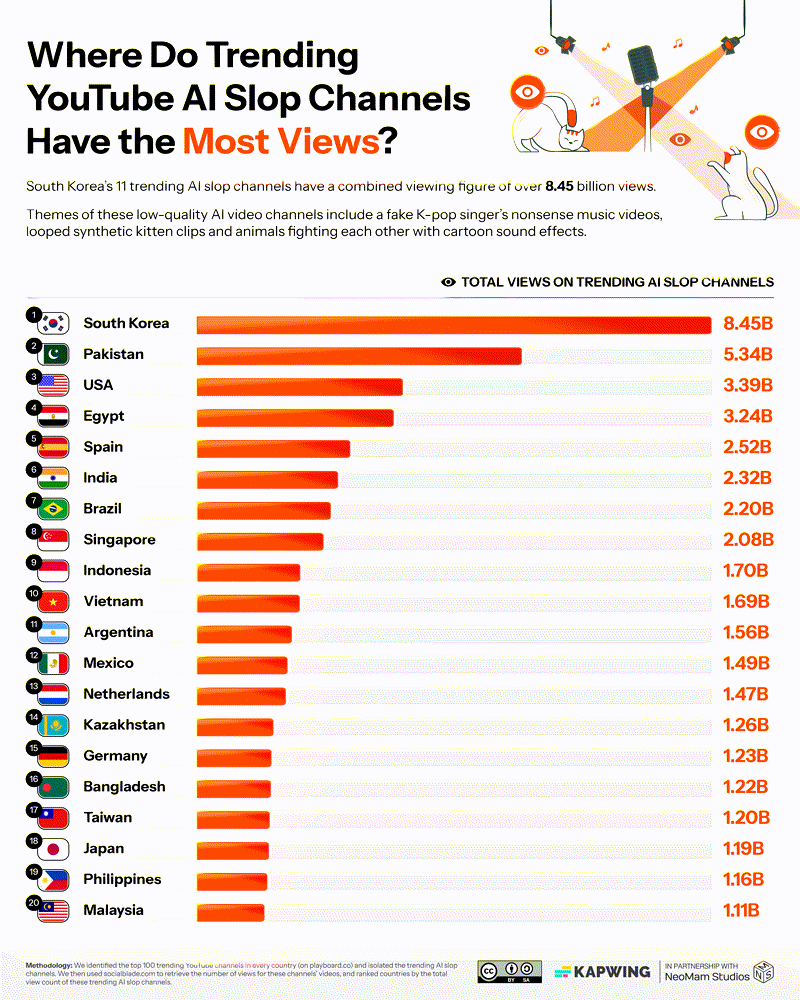
The numbers on AI slop videos are crazy.

Five of the other ten trending AI slop channels with the most views are based in South Korea, with others in Egypt, Brazil and Pakistan. But the channel with the most views of all is in India. Bandar Apna Dost features over 500 videos, mainly “featuring a realistic monkey in hilarious, dramatic, and heart-touching human-style situations,” Many of which are variations on identical set-ups. The channel also has around 100,000 followers on Instagram; on Facebook, the videos are attributed to a ‘digital creator’ named Surajit Karmakar.

Note

Intellectual bacchanalia

There two stunning things in this tweet: I use Claude Code heavily and it’s bloody amazing. That it can help a non-technical person like me to turn my ideal into reality still shatters my mind everyday, even after using Claude Code on an almost daily basis for over a year. It’s magic! I can’t believe it was a side…

Read the note →
Note

Summoning Ghosts: Why You Need to Try AI Coding Tools

Note: This is stream of consciousness. I’m working through my thoughts on AI coding tools in real time, and I’m not interested in being measured about it. I woke up this morning and I’m nodding my head so much in agreement that if I keep this up, there’ll be a new medical disorder named after me—the nodding head…

Read the note →
Note

Self improving systems are not possible

Interesting framing by Daniel Jefferies:

Infinitely self recursively improving systems are impossible.

It’s impossible to make a system that can correct all its own mistakes when it is the very thing making the mistake in the first place.

How do I know?

Evolution hasn’t figured it out in millions of years, why would we figure it out in two or two hundred?

Your brain is a bunch of crude hacks. Wonderful hacks and amazing hacks but crude nonetheless.

When you have to figure out if something is “true” or “real” you don’t actually come to any concrete, real, objective truth most of the time.

Instead, we have a ton of micro approximations in our heads that sorta, kinda get closer to an approximation of reality/truth, though sometimes they are way the hell off.

Note

Why AI is not a bubble

I didn’t fully understand the technical details in this analysis but Matt Dratch makes the case that the despite massive AI build up, we’re still massively short on compute:

The core finding: even under generous assumptions about hardware efficiency and utilization, we are likely 8–50x short on compute for consumer inference alone in a mature agentic and multimodal world. This is
before accounting for enterprise, sovereign, robotics, or training demand.
Three claims underpin this framework:

1. Tokens are the kWh of knowledge work. As price falls, users don’t ask the same questions more
cheaply; they ask orders-of-magnitude richer questions involving tools, memory, video, audio, and
sensors.

2. The installed base of frontier AI compute is ~13 GW globally (low 20s by some estimates). The
entire 125 GW of existing data center capacity will eventually convert to accelerated compute, and then
we’ll build beyond that.
3. Cluster-level efficiency is 5–10% of chip specs once you account for MFU, power distribution, and
fleet mix.

Note

A dumb model of AI

I have a dumb model for thinking about AI: keep using it and reason forward. Everything is frankly narrative pollution to me. I find most debates about AI, intelligence, AGI, ASI, and other things largely unhelpful. I’m not saying they are useless; what I am saying is that they are personally unhelpful to me. The best…

Read the note →
Note

AI is overdelivering

AI might be a bubble, but the smart people are using these tools to extract value. My personal take: whether AI is a bubble or not matters to the investors betting on it. The rest of us normies should shut the fuck up and abuse the VC subsidy that’s making these awesome tools accessible for so cheapest. I’m saying this…

Read the note →
Note

Claude Code is awesome, but terribly named

It feels like off late all I am doing here is linking to Simon Willison, but he’s on the money here: Claude Code is, with hindsight, poorly named. It’s not purely a coding tool: it’s a tool for general computer automation. Anything you can achieve by typing commands into a computer is something that can now be…

Read the note →
Note

The debt part of the AI cycle

So U.S. companies issued 1.7 trillion worth of investment-grade bonds, of which Goldman estimates 30%—which is 510 billion—was because of AI boom. Now things are getting interesting. You know, as things start making their way from equity issuance to debt, things become really, really interesting. Because if this AI is…

Read the note →
Note

The case against superintelligence

I just finished reading this thoughtful post by Tom Dettmers in which he argues that we won’t reach artificial general intelligence or super intelligence. It was a bit technical for me so I asked NotebookLM to simplify it for me: This blog post by Tim Dettmers argues that the popular idea of \\Artificial General…

Read the note →
Note

AGI for normal people is here

Amen. Fullly agree with what Deam Ball is saying. I agree with all this; it is why I also believe that opus 4.5 in claude code is basically AGI. Most people barely noticed, but \it is happening.\ It’s just happening, at first, in a conceptually weird way: Anyone can now, with quite high reliability and reasonable…

Read the note →
Note

Predictive AI > Generative AI

Generative AI is sexy, but predictive AI is useful. To get a sense of the immense progress on predictive AI and its future potential, we can look at the trajectory of the past 20 years. In 2005, we couldn’t get AI to tell the difference between a person and a pencil. By 2013, AI still couldn’t reliably detect a bird in…

Read the note →
Note

We are summoning ghosts with LLMs

Brilliant post as usual by Andrej Karpathy: 2025 is where I (and I think the rest of the industry also) first started to internalize the “shape” of LLM intelligence in a more intuitive sense. We’re not “evolving/growing animals”, we are “summoning ghosts”. Everything about the LLM stack is different (neural…

Read the note →
Note

Be human

Hmm 🤔

Humans should remain smarter than their refrigerators. It is insane that we are living in a time in which people are trying to make refrigerators smarter, but are satisfied to dumb down themselves and those around them. All the evidence suggests that AI is bad for your brain. If you use it as a salve for social and romantic frustration, it also makes it harder for you to connect with others and less resilient in the face of real life. If you let AI create more distance between you and words and language, you are allowing it to threaten some of the most important distinctions between humans and animals.

AI is sold to us on the premise that it can offer us life on easy mode. No such mode exists. Life is for living, not escaping. Be human. Read human.

AI? Hard pass. Be human. Read human.

Note

On China and chips

Thoughtful piece by Robert Wright parsing out the inconsistencies in the opinions of various factions that opposite selling advanced NVIDIA chips to China: The grave dangers AI safety hawks worry about can’t be adequately addressed without extensiveo international cooperation—cooperation tight enough to qualify as…

Read the note →
Note

Vibe engineering

We’re moving from vibe coding to vibe engineering:

Turns out it was almost all built by LLMs

At this point I went looking for some more background information on the library and found Emil’s blog entry about it: How I wrote JustHTML using coding agents:

Writing a full HTML5 parser is not a short one-shot problem. I have been working on this project for a couple of months on off-hours.

Tooling: I used plain VS Code with Github Copilot in Agent mode. I enabled automatic approval of all commands, and then added a blacklist of commands that I always wanted to approve manually. I wrote an agent instruction that told it to keep working, and don’t stop to ask questions. Worked well!

Emil used several different models—an advantage of working in VS Code Agent mode rather than a provider-locked coding agent like Claude Code or Codex CLI. Claude Sonnet 3.7, Gemini 3 Pro and Claude Opus all get a mention.

Note

Ads everywhere

Ads are coming to AI platforms one way or another.

I agree.

Here’s what I think will happen in 2026:

AI platforms will start offering paid placement within conversations where clear purchase intent signals are evident.

The ads will be clearly labeled as sponsored, and they will likely tie into direct purchase opportunities.

Eventually, ads will also appear embedded in other types of interactions, such as inspiration (where should I take my family on spring break?) and research (what are the best resorts near Disney World?), effectively turning AI chats into a new media channel.

Note

How many jobs can AI kill

A

I’m confident that AI is not going to wipe out anywhere close to 25M jobs on net over the next decade. If technological shocks caused net, long-run displacement, employment in the US would be 0. Instead, it’s among its highest peacetime age-adjusted levels. But… 1/2

…AI could absolutely drive gross displacement; think of automobiles displacing horse-related jobs even as they created new types of auto manufacturing & services jobs. That’s painful for workers, especially in the short-run & especially for workers in jobs more automatable.

Important to note however that even the amount of gross displacement from AI is highly uncertain; most of its use cases so far augment some tasks rather than replacing entire jobs.

Note

AGI will be business as usual?

What if this version of “business as usual” reality comes true. Seems like a good frame to have in your mental toolbox when thinking about the future path of AI. in a post-AGI world, people will simply get used to the fact that computers can solve cognitive problems quickly, and beat us in any cognitive domain, just…

Read the note →
Note

What to expect when expecting

This is the most intellectually honest opinion to have about AI.

Philippe Lemoine

I think that if progress in generative AI continues, which I’m pretty sure it will (it doesn’t even have to continue at the current pace as long as decreasing marginal returns don’t hit too hard), cultural products will become massively diversified.

One factor that limits the diversity of cultural products is that they tend to have high fixed costs, so you need a large enough audience for them to be profitable.

But if generative AI massively reduces the cost of production, which it almost certainly will, then there should be an explosion of tailor-made cultural products.

I think this has the potential to have significant effects on society, though it’s hard to say what they will be exactly, because it means that people will have less cultural references in common.

Note

AI blind spot

This is an interesting take by Daniel Rock:

I don’t happen to believe AI is going to take away all of the jobs. But it is possibly a blindspot-generating issue that the people studying AI’s impacts mostly love their jobs

Note

Post-cognitive world

Interesting take by Like Burgis. This is stuck in my mental craw for some reason: I would also now add a surprising element to my 2024 essay: as the cost of cognition approaches zero, that which is repeatable will be replaceable—and will indeed be replaced—by AI (a favorite saying of Palantir Co-Founder Stephen Cohen)…

Read the note →
Note

Can AI eliminate information advantages

Interesting article in the Economist on how AI can help customers being ripped off: The extent to which AI truly eliminates rip-off markets depends on two things. First, consumers need to know how to use AI properly. Mindlessly repeating advice from ChatGPT is less effective than using the bot as a learning tool that…

Read the note →
Note

Economic impact of AI

I’m still reading through this brilliant and thoughtful post by Tom Cunningham, but it’s so thoughtfully written. 1. There is no standard definition of machine intelligence. There have been many attempts to give a definition or a metric of machine intelligence but most have been unsatisfactory. The lack of a common…

Read the note →
Note

Institutional impact of AI

Interesting take on the institutional impact of AI by Will Rinehart: A lot of people are likening the advent of AI to moveable type. The printing press brought about the conditions for the Reformation, therefore significant institutional change is coming with AI. But when you look at how print changed cultures other…

Read the note →
Note

The value of education in the shadows of AI

Thoughtful essay on the role of colleges in the age of AI:

The Question We Can No Longer Dodge

If AI can already produce an A– college essay in 30 seconds — on demand, at scale — then what exactly is college for?

Is it certification? Content delivery? A rite of passage? Social sorting?

Because if a machine can now flawlessly mimic the outputs we’ve long treated as evidence of learning, then the value of higher education can no longer rest on product. It must rest on the formation of actual human capability — judgment, originality, ethical reasoning, collaborative intelligence, and the ability to think in public under pressure.

Unless universities can actually do that— with conviction, not nostalgia; through redesign, not rhetoric — they will lose not only the public’s confidence, but something even more fatal: the employers’ trust that a degree still signals real human competence.

Note

AI is kicking your butt; just accept it

If LLMs aren’t making you feel like shit, you’re not thinking hard enough: During the Q and A after his talk, Cowen said that LLMs are already “kicking our butt” at many things, including poetry. In fact, Cowen insisted, LLMs already write poems that are as good as the median poem by Chilean Nobel Prize-winner, Pablo…

Read the note →
Note

How Terence Tao uses AI

Here’s how the great Terrence Tao uses AI. Lot’s of takeaways here for us lesser mortals. I was able to use an extended conversation with an AI to help answer a MathOverflow question . I had already conducted a theoretical analysis suggesting that the answer to this question was negative, but needed some numerical…

Read the note →
Note

AI links

As always, another thoughtful article by Ethan Mollick on what AI can and cannot do: Agents are here. They can do real work, and while that work is still limited, it is valuable and increasing. But the same technology that can replicate academic papers in minutes can also generate 17 versions of a PowerPoint deck that…

Read the note →
Note

How Americans use AI and what they think about it

Pew published a report on how Americans use and view AI, and it’s quite interesting. Americans are much more concerned than excited about the increased use of AI in daily life, with a majority saying they want more control over how AI is used in their lives. Far larger shares say AI will erode than improve people’s…

Read the note →
Note

How long do we have left?

Google DeepMind’s Gemini and OpenAI achieved gold-medal-level performance at the 2025 International Collegiate Programming Contest (ICPC) World Finals. OpenAI’s Mostafa Rohaninejad: We officially competed in the onsite AI track of the ICPC, with the same 5-hour time limit to solve all twelve problems, submitting to the…

Read the note →
Note

A hopeful view of large language models (LLM)

File this under hopeful naïveté, naïve idiocy, or pointlessly hopeless romanticism. I was playing around with Gemini’s new image model, NanoBanana, and I was shocked at how good it was. That got me thinking about the present state of AI tools—by which I mean large language models (LLMs). People often use “AI” to mean…

Read the note →
Note

I got some links for you

File under US-China tech cold war. Anthropic to stop selling services to Chinese companies: The policy, which takes effect immediately, will potentially apply to Chinese companies from ByteDance and Tencent to Alibaba. “We are taking action to close a loophole that allows Chinese companies to access frontier AI,” said…

Read the note →
Note

What is artificial intelligence (AI)?

Benedict Evans is one of the most thoughtful writers on technology. Whenever I listen to him, I end up feeling embarrassed, because I keep thinking: why can’t I think like that? 😬 Unlike many other commentators, Ben has a very practical and measured view of AI. One thing I love is how he goes about defining what AI…

Read the note →
Note

Bhuvan’s law

I was listening to a conversation between Jack Clarke, co-founder of Anthropic, and Tyler Cowen. It was an interesting conversation with some interesting things that made me go, “Ooh, that’s interesting,” and a lot of vague, hand-wavy, speculative predictions that are unknowable, unprovable, and hard to mentally…

Read the note →
Note

Vibe Physics? Not Yet

Sabine Hossenfelder tried to “vibe physics” using popular LLM models, and she was underwhelmed. So if you’re a physicist, I guess your job is safe for now. I’m not a physicist myself, and I couldn’t understand half the things Sabine said. That said, she points out that the current crop of LLMs are good at literature…

Read the note →
Note

On AI-assisted writing

I’m a huge fan of Venkatesh Rao’s writing and I reread this essay on his experience with AI-assisted writing. Now that pretty much everybody has access some basic large language models (LLMs) through the free plans of ChatGPT or the better Chinese models like DeepSeek and Qwen, is there a need to go through the manual…

Read the note →
Note

On AI taking jobs

Making sense of reality as it unfolds is always hard because of the variance in outcomes. With Artificial Intelligence, that difficulty compounds massively. Both the narrative variance and the actual variance of potential AI outcomes are so vast that having strong opinions isn’t really a luxury one can afford. If one’s…

Read the note →
Note

Universities in the age of AI

Hollis Robbins is one of the most thoughtful commentators on how artificial intelligence is reshaping education. Her latest piece is, once again, bang on the money. She has consistently pointed out the futility or rather, the growing obsolescence of modern university education ie., That is the information delivery and…

Read the note →